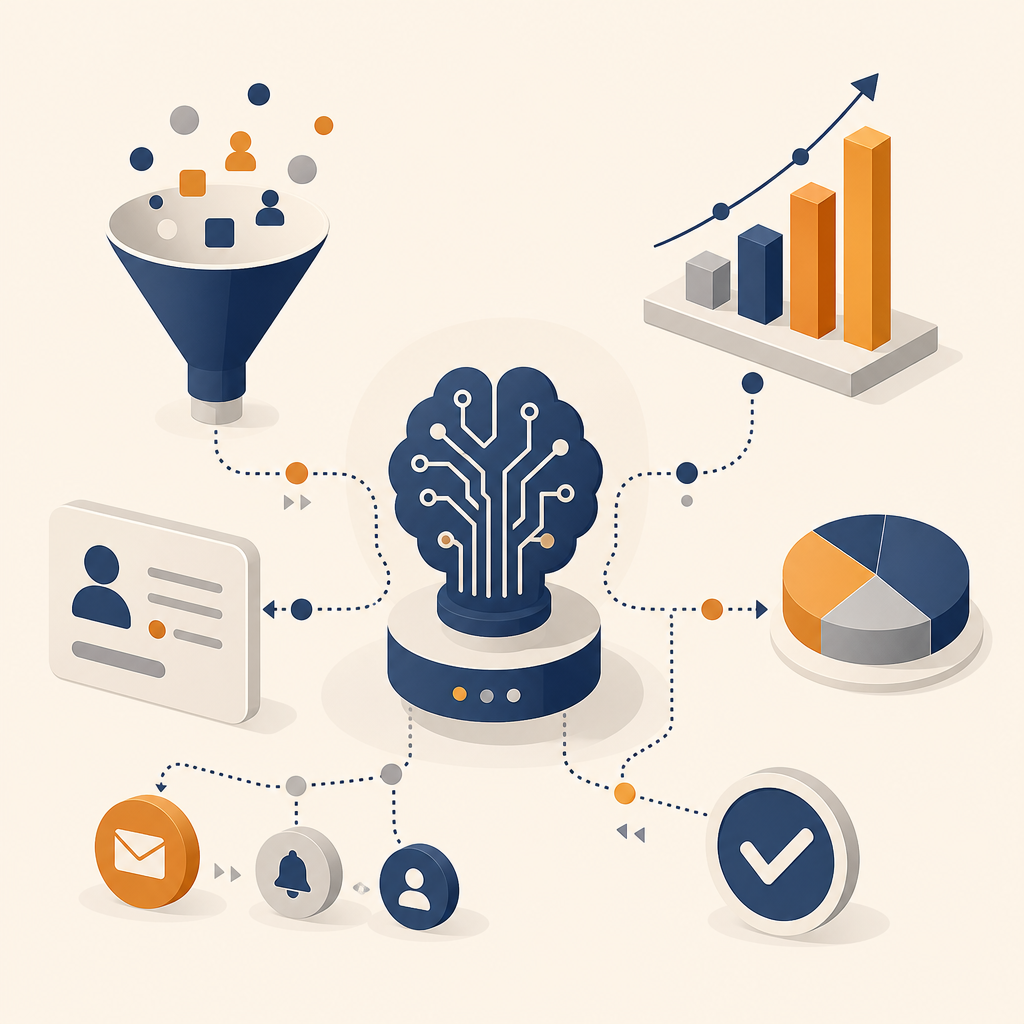
A CRM used to be where sales data went once the work was already done: a system of record a rep updated after a call ended, if they remembered. AI-powered CRM software runs the other way. It listens to calls, emails, and meetings as they happen, builds records without anyone typing them in, and can act on what it finds instead of waiting for a person to notice a deal has gone quiet.
That distinction is what “AI-powered” should mean when evaluating CRM software. A chat box that answers questions about a pipeline is a feature. A system that reads a transcript, updates the deal stage, and drafts the follow-up email on its own is a different category of product, and the one worth paying for.
What separates real AI from a bolt-on
Most CRM platforms now claim some form of AI. Few do the same thing with it. Four questions separate the systems that hold up from the ones that added a chat icon to an existing sidebar.
- Does it capture data without being asked? Calls, emails, and meetings should populate records automatically. If a rep still has to log a call by hand, the AI is decoration.
- Does it act, or only answer? A useful system flags a stalled deal, drafts the follow-up, and updates the stage on its own. A search bar that summarizes what already happened is a smaller win.
- Does it reason across the whole record, not one field at a time? Scoring a deal or drafting an email needs the full history, past calls, every email thread, product usage, not just whatever sits in the field the AI was pointed at.
- Can it be trusted with permissions? An agent that reads and writes CRM data needs the same access controls as the person it acts for, not a blanket key to the whole workspace.
The AI-powered CRM platforms worth evaluating
- Attio is the agentic CRM built around a single context layer: every email, call, and meeting lands there as a signal, and Ask Attio, Workflows, and AI Attributes all act on it directly, from scoring a deal off a call transcript to drafting the follow-up. Its data model reconfigures without an engineering ticket, so the AI layer keeps up as the process changes shape. It’s the newest platform of the four here, so migrating a large team’s multi-year history takes more upfront planning than staying on an entrenched incumbent.
- Salesforce, through Agentforce, gives admins a way to turn existing flows and Apex logic into autonomous agents that reason step by step and pull from a governed Trust Layer. It’s the deepest option here for a team that already runs complex, custom Salesforce logic and wants to extend it with agents rather than replace the system underneath. The tradeoff is the one that has always applied to Salesforce: an admin team to build and maintain it.
- HubSpot’s Agent Hub bundles prospecting, customer support, and data-lookup agents into the same system as its marketing and service tools, suited to a team that wants AI across the whole customer lifecycle without stitching platforms together. Agent usage bills on a consumption basis on top of seat cost, so a heavy AI workload changes the bill more than a flat per-seat plan would.
- Zoho’s Zia AI scores deals, flags anomalies in the pipeline, and drafts emails at a price well below the other three, making it the practical choice for a team that wants AI features without an enterprise budget. It won’t match the reasoning depth of a purpose-built agent platform, but for lead scoring and forecasting, it covers the basics.
How to test one
Ask each vendor for a real AI-run task, not a demo: point the system at a genuinely messy account with a long email history and ask it to produce a summary and a next step. The gap between a good answer and a generic one shows up faster than any feature comparison chart will.
The AI layer is not the whole decision, so weigh it against the rest of the evaluation: pricing, data model, and how the platform holds up once fifty reps are logging into it every day. The best CRM software for revenue teams covers that wider comparison once the AI shortlist is narrowed down. A five-person team without an admin to spare should start narrower, with our guide to the best CRM for small teams instead.